

How Much can an S-Corporation Save?
Reducing Tax by Applying Best Practices
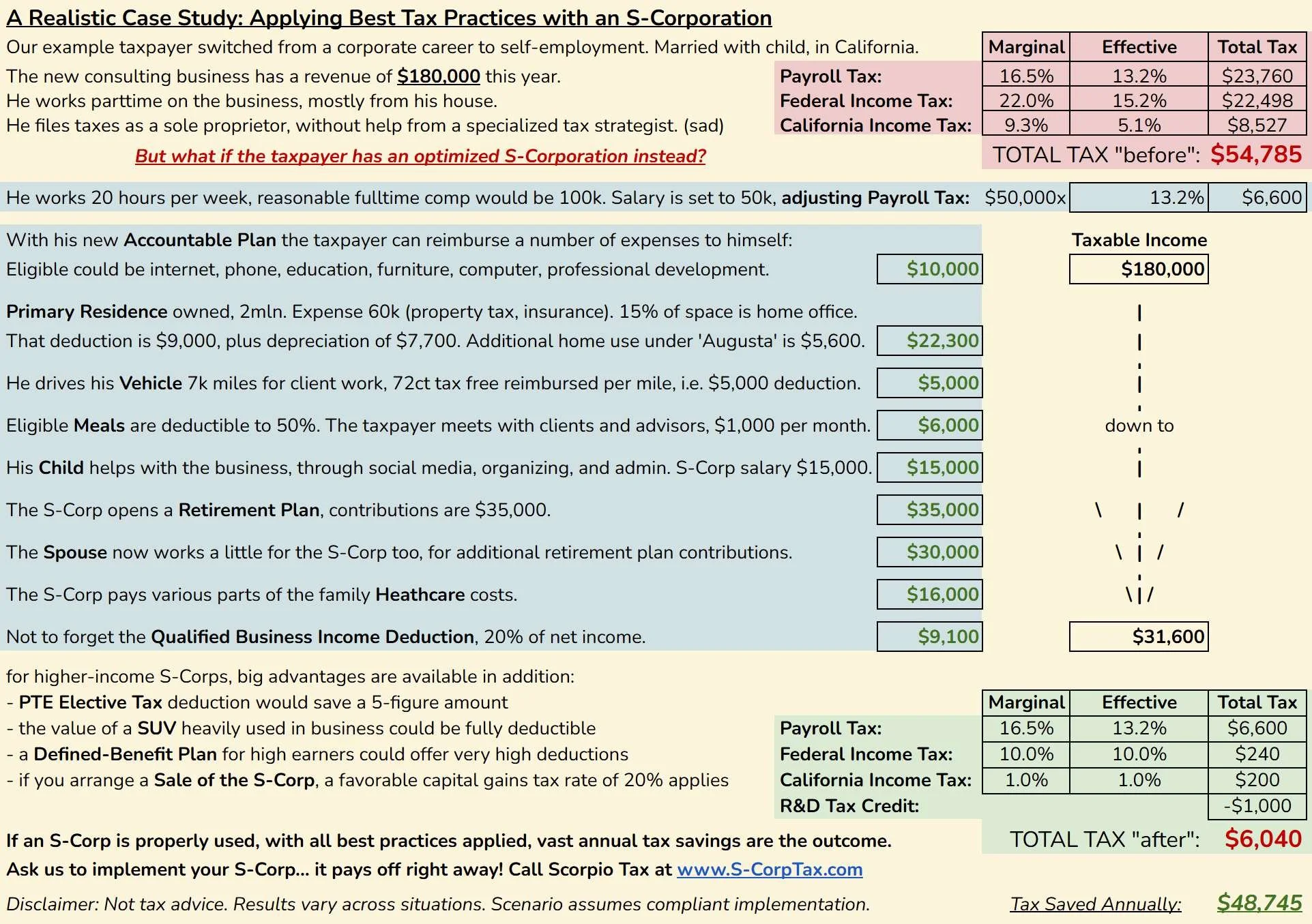
A Realistic Case Study: How Applying Best Tax Practices with an S-Corporation Can Dramatically Reduce Your Tax Burden
Our example taxpayer made the leap from a traditional corporate career to self-employment as a consultant. He is married with a child and lives in California. His new consulting business generated significant revenue this year. He works part-time, primarily from his home office, and had been filing taxes as a sole proprietor with only basic tax preparation help and no specialized strategic guidance.
Like many business owners in this situation, he was unknowingly overpaying taxes significantly.
The “Before” Scenario – Filing as a Sole Proprietor
Without proactive tax planning or an optimized business structure, this taxpayer faced a heavy tax burden. He was responsible for the full self-employment tax on his entire profit, plus both federal and California state income taxes. In total, his combined payroll/self-employment taxes, federal income tax, and California income tax resulted in a very substantial annual tax bill.
The “After” Scenario – A Properly Optimized S-Corporation
Now let’s look at what happened when the same taxpayer switched to a well-structured and professionally managed S-Corporation, with all the best practices properly implemented.
By working with a specialized tax strategist, he was able to take advantage of numerous powerful tax planning tools specifically designed for S-Corporation owners. Here are the key strategies that were applied:
Reasonable Compensation Strategy
Instead of paying self-employment tax on the entire business profit, the S-Corporation paid him a reasonable salary. This significantly reduced the payroll tax burden, as self-employment taxes only applied to the salary portion, not the remaining profits distributed as dividends.
Accountable Plan for Tax-Free Reimbursements
Using a formal Accountable Plan, the S-Corporation was able to reimburse the owner for legitimate business expenses on a tax-free basis. Eligible expenses included internet, phone, education, office furniture, computer equipment, and professional development.
Home Office and Residence-Related Deductions
The taxpayer owns his primary residence. By properly documenting the business use of his home, he was able to deduct a significant portion of property taxes, insurance, utilities, and depreciation. In addition, he utilized the Augusta Rule to allow limited personal use of the home for business purposes, generating another valuable deduction.
Vehicle Expense Reimbursements
He drove thousands of business miles for client meetings and other work-related activities. Through the S-Corporation’s Accountable Plan, he was able to reimburse himself at the standard IRS mileage rate on a tax-free basis.
Business Meals
Client meetings and meetings with advisors generated deductible business meals. The S-Corporation was able to deduct 50% of these qualified meal expenses.
Employing Family Members
The taxpayer’s child assisted with social media, organizing, and administrative tasks, receiving a legitimate salary from the S-Corporation. His spouse also began working part-time for the business. These arrangements allowed for additional payroll deductions while creating opportunities for family retirement plan contributions and shifting income within the household.
Retirement Plan Contributions
The S-Corporation established a retirement plan and made substantial contributions on behalf of the owner and spouse. These contributions are deductible at the corporate level and grow tax-deferred.
Health Insurance and Family Benefits
The S-Corporation covered various portions of the family’s healthcare costs, providing another layer of tax-efficient benefits.
Qualified Business Income (QBI) Deduction
The owner was able to claim the 20% Qualified Business Income Deduction on the S-Corporation’s qualified income, further reducing taxable income.
Additional Tax Credits
The business also qualified for a Research & Development (R&D) tax credit, generating an additional tax benefit.
The Dramatic Difference
When all of these strategies were properly implemented together, the taxpayer’s total tax burden dropped dramatically — from a very high amount down to a small fraction of the original figure.
This case study clearly illustrates the massive difference between simply “filing taxes as an S-Corp” versus fully optimizing an S-Corporation with best practices.
Even Greater Opportunities for Higher-Income S-Corps
For business owners with higher earnings, additional powerful strategies become available, including:
- The Pass-Through Entity (PTE) Elective Tax deduction, which can save a significant five-figure amount in California
- Section 179 and bonus depreciation on vehicles (such as a heavily used SUV)
- Defined-Benefit Retirement Plans allowing much larger deductible contributions
- Favorable capital gains treatment in the event of a future sale of the business
The Bottom Line
An S-Corporation election by itself is only the beginning. The real tax savings come from the proper implementation of all available best practices — reasonable compensation, accountable plans, family employment, retirement planning, home office strategies, and more.
Many business owners leave tens of thousands of dollars in potential tax savings on the table every year simply because they don’t have a specialized tax team guiding the strategy.
Ready to Optimize Your S-Corporation?
At Scorpio Tax Management, we help S-Corporation owners, LLCs considering conversion, and growing businesses implement these exact strategies in a compliant, defensible, and highly effective manner.
Schedule a confidential introductory call with our team today. We’ll analyze your current situation, income profile, and goals, then provide a clear, personalized blueprint of the opportunities available to you.
Disclaimer: This case study is for illustrative purposes only. Results vary significantly based on individual circumstances. Scenario assumes compliant implementation and proper documentation. Not tax advice.
Don’t attempt to handle your tax situation all by yourself… work with professionals!
The trouble and money a good tax strategist can save you often pays off right away.
Scorpio Tax Management can help you.
There’s no cost to have a first conversation.
We are Enrolled Agents, licensed directly by the IRS to advise and represent taxpayers.